



The Great Green Flush: Turning Wastewater into Ottawa’s Cleanest Energy
- Feb 14
- 4 min read
Updated: Mar 11
A landmark transformation is underway at Ottawa’s LeBreton Flats, where a groundbreaking energy project is turning the city’s wastewater into a primary power source.

Client: Dream
Location: 665 Albert St. (LeBreton Flats), Ottawa, Ontario
Architects: KPMB Architects and Perkins&Will, supported by Two Row Architect
Size: 706,108 ft² / 65,600 m²
Completion Date: 2027
Sustainability: Zero Carbon Building—Design Standard™; LEED Gold certification
Project Type: Mixed-use, Residential
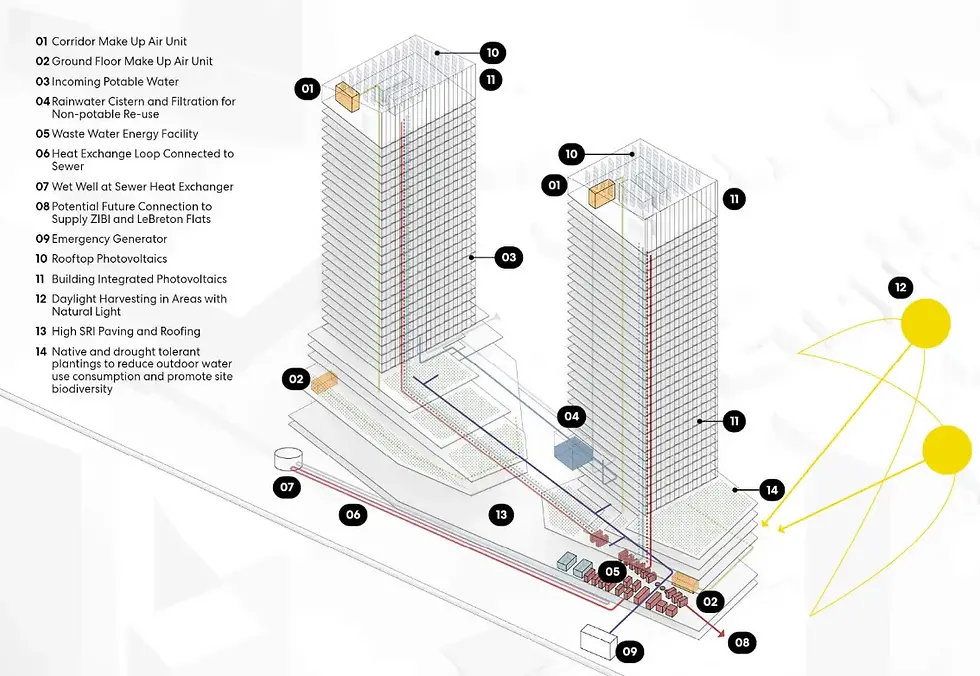
Through a partnership between the City of Ottawa, Hydro Ottawa (via Envari Holding Inc.), and Theia Partners, the new LeBreton Community Utility is set to implement an advanced Sewage Energy Exchange System (SEES).
This system will provide carbon-free heating and cooling for Odenak, a flagship 600-unit residential development that serves as a model for the future of sustainable, inclusive urban living.
Harnessing the "Thermal Potential" of Sewage
At the heart of the project is Canadian innovation from SHARC Energy Systems. The SEES technology works by diverting raw sewage from the municipal collection system into an external wet well. From there, the wastewater is filtered and passed through high-efficiency heat exchangers and heat pumps to extract thermal energy.
Once the energy is captured for heating or cooling the buildings, the sewage is simply discharged back into the municipal line. This "circular" approach offers several staggering benefits:
Massive Scale: The system will provide 9 megawatts of thermal capacity, enough to support approximately 2.4 million square feet of development.
Carbon Reduction: It is estimated to reduce greenhouse gas emissions by 5,066 tonnes annually—the equivalent of the electricity used by over 3,300 homes.
Fossil-Fuel Free: In a first for the nation’s capital, the system operates entirely without the use of boilers or traditional chillers.
“This partnership demonstrates how we can use existing infrastructure in new and innovative ways to reduce emissions and support sustainable growth in our communities of the future. By turning wastewater into clean, efficient energy, we’re taking a practical step that shows what’s possible when innovation meets sustainability in city building. This is great for the environment and for a clean future in Ottawa.” Mayor Mark Sutcliffe, City of Ottawa
Odenak: A "Village" Built on Equity
The primary beneficiary of this energy network is Odenak (the Algonquin word for "community" or "village"). Located at 665 Albert Street, the project consists of two towers—30 and 35 storeys—designed by a joint venture of KPMB Architects, Perkins&Will, and Two Row Architect.
While the energy technology is impressive, the project’s social architecture is equally ambitious. Odenak is designed to be one of Canada’s largest Zero Carbon Building residential projects, with a core focus on affordability:
Inclusionary Housing: 41% of the 600 units (247 units) are designated as affordable housing.
Diverse Support: Through a partnership with the Multifaith Housing Initiative (MHI), 133 units are specifically earmarked for Indigenous peoples, veterans, newcomers, and adults with cognitive disabilities.
Universal Design: Over 30% of the units and all amenity spaces are designed to be barrier-free and fully accessible.
Architecture That Honours the Land
The design of Odenak is a tribute to the Algonquin Anishinàbe people and the natural history of the Ottawa River site. The building’s podium mirrors the escarpment of the Gatineau Hills, while the vibrant red cladding of the towers—designed in collaboration with artist Margaret Priest—evokes the autumn colours of the Laurentian Forest.
A central "gathering circle" between the towers provides a public social space, reinforcing the Indigenous principles of connectivity and stewardship.

A Blueprint for the Future
The SEES project is not just a one-off installation; it is a proof-of-concept for the rest of North America. The National Capital Commission (NCC) is already in talks to expand the network to other land parcels at LeBreton Flats.
With construction on the sewer infrastructure connection slated to begin later this year, and SHARC Energy set to deliver the system throughout 2026, Ottawa is positioning itself as a leader in the global shift toward smart, equitable, and carbon-neutral energy.
“We are honoured to contribute to such an innovative solution that not only pushes the boundaries of technology but also fosters a more sustainable future. This project reflects our commitment to advancing environmentally responsible practices and delivering the most advanced HVAC solutions.” Wael Khalaf, HTS Engineering and SHARC Energy’s Ontario representative.
The Towers are Rising: Dream LeBreton
If you’ve driven down Albert Street recently, you know the "quiet years" at LeBreton Flats are officially over. As of February 2026, the area has transformed into one of the busiest construction zones in the country.
The Status: The exterior "stone and wood" facade is nearing completion. Inside, crews are currently working on the interior fit-out, including a stunning five-storey atrium.
The Delay: Recent updates confirmed that due to the building's complexity, the grand opening has been pushed from summer 2026 to late 2026/early 2027. It’s taking longer, but the craftsmanship looks incredible.
Image courtesy of: KPMB Architects Image courtesy of: KPMB Architects Image courtesy of: KPMB Architects Image courtesy of: KPMB Architects
A New Standard for Urban Living
The LeBreton Flats transformation represents a rare alignment where cutting-edge engineering meets a profound social conscience. By literally finding "hidden treasure" in the city’s wastewater, Ottawa is proving that the path to a net-zero future doesn't have to be a choice between environmental stewardship and urban growth.
As the project moves toward its 2027 completion, it stands as a living laboratory for the "post-pandemic" city—one that is resilient, carbon-neutral, and, most importantly, accessible to everyone. In a world where urban infrastructure is often invisible and impersonal, the SEES technology and the Odenak development bring it to the forefront, reminding us that even our most basic municipal systems can be reimagined to protect the planet.
Image courtesy of: KPMB Architects Image courtesy of: KPMB Architects Image courtesy of: KPMB Architects Image courtesy of: KPMB Architects Image courtesy of: KPMB Architects Image courtesy of: KPMB Architects


