




Practice Before Practice: Why the Design Industry Needs to Break the Classroom Bubble
Apr 20
4 min read
For decades, the design, architecture, and engineering worlds have followed a strict, sequential script: learn first, practice later. Students spend years perfecting theory in academic bubbles, only to graduate and crash into the hard realities of budgets, building codes, and client demands.
But what if education and practice weren’t isolated stages, but a shared ecosystem?
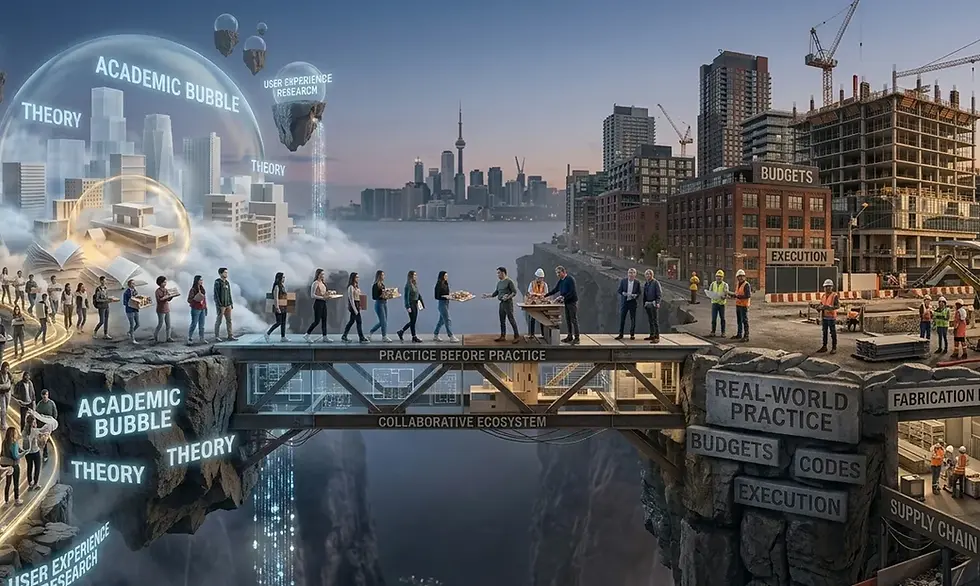
A recent collaboration in Toronto proves this isn’t just a nice idea—it’s a better business model. By pairing Toronto Metropolitan University’s (TMU) fourth-year interior design students with Mason Studio and student housing developer HOEM, the Practice Before Practice exhibition lets emerging designers tackle real building outcomes before they even graduate.
The result? A massive win for both the seasoned pros and the incoming talent. Here is why this model is the future of design.
The Developer’s Edge: Why Pros Need Fresh Eyes
For established firms and developers, bringing students into a live project isn’t charity—it’s a strategic advantage. Professional practices naturally develop blind spots; they get used to doing things "the way they've always been done". Students disrupt this operational inertia.
They Challenge the Status Quo: Free from industry baggage, students question the fundamental "whys" behind standard choices, reopening creative doors that veteran teams might have prematurely shut.
They Foster a Culture of Testing: The presence of eager, emerging talent encourages professional studios to experiment more openly rather than rushing to the safest, fastest resolution.
They Create a Seamless Talent Pipeline: Working side-by-side acts as a live audition. Developers get to cultivate and hire a future workforce that already understands their specific workflows and culture.
The Student’s Reality Check: Theory Meets Execution
For students, stepping into an active developer’s environment is the ultimate reality check. Academia is great for conceptual thinking, but it shelters students from the complex negotiations required to actually build something. In the real world, success relies less on unrestrained creativity and more on ruthless problem-solving.
Constraints Cure the "Blank Page": Real-world limitations—like material weight, durability, and strict budgets—don't stifle imagination; they focus it. These constraints pushed TMU students to master practical fabrication techniques, such as CNC milling and working with steel.
Ego Takes a Backseat: In a university studio, projects are often expressions of personal taste. In the field, a designer’s value is rooted in executing a client's vision. Students learned to trade ego for strategic execution.
Confidence Through Agency: Real projects require making tough calls. When faced with complex, high-tech suggestions for a lighting installation, the TMU students weighed the timeline against the mechanics and confidently advocated for sticking to their original, highly functional design. They didn't just learn design; they learned pushback.
The Old Way vs. The New Blueprint
The Traditional Academic Model (The Old Way)
Historically, design education has kept students isolated within university studios. Their work is largely unbounded, relying on hypothetical "blank page" scenarios where the primary goal is often personal creative expression. Because students are separated from the industry, transitioning into the professional world can feel jarring, and networking is frequently reduced to awkward, forced mixer events rather than genuine connections.
The "Practice Before Practice" Model (The New Blueprint).
In contrast, this new approach integrates students directly into active, live developer projects. Instead of being intimidated by a blank page, students find their creativity catalyzed by real-world constraints like budgets, physics, and client demands. The focus shifts from personal expression to the strategic execution of a shared vision. As a result, networking happens naturally—it becomes an organic byproduct of daily collaboration and shared problem-solving with seasoned professionals.
Building the Invisible Foundation
Perhaps the most lasting impact of this model is the rapid development of soft skills. When students have to communicate with developers, professors, and tradespeople actively, they learn to navigate competing agendas, ask sharper questions, and take feedback on the chin. It also demystifies networking, proving that it isn't about putting on a facade—it’s about genuine curiosity and doing good work together.
The collaboration between TMU, Mason Studio, and HOEM is a clear blueprint for the future. By dissolving the boundary between the classroom and the construction site, we can give emerging designers a safer runway to launch their careers, while injecting real estate projects with bold, unconstrained thinking.


