A Culturally Significant Complex for the Cree Nation: The Eeyou Istchee Regional Health Centre
Feb 27
3 min read
Serving nine communities across the Cree traditional territory of Eeyou Istchee—a population of approximately 20,000—this new $300-million facility will be seven times the size of the region’s current hospital.
Erected in the heart of Chisasibi, the future Eeyou Istchee Regional Health Centre (EIRHC) is set to become a vital hub for the region. Designed to replace an outdated 1980s facility and consolidate community health services currently housed in trailers, the new center is eagerly awaited. With the nearest hospital located nearly 1,000 kilometres away in Val-d’Or, the EIRHC will bring essential surgical, medical, telemedicine, and diagnostic capacities directly to the region.
Designing this facility is a privilege, and the architectural consortium of Figurr, Jodoin Lamarre Pratte, and Lemay has created a concept deeply rooted in the values and traditions of the Cree Nation.
"The Regional Health Centre will be a big facility, but it is not just about steel and concrete. First and foremost, it’s about people – responding to the human needs of the Crees through human care. But the new facility is concrete in a sense: it gives concrete expression to the vision in Section 14 of the James Bay and Northern Quebec Agreement of bringing health and social services home to the Crees of Eeyou Istchee. This is the vision restated in the Board’s Strategic Regional Plan." Grand Chief Dr. Abel BosumGrand Council of the Crees (Eeyou Istchee)/Cree Nation Government
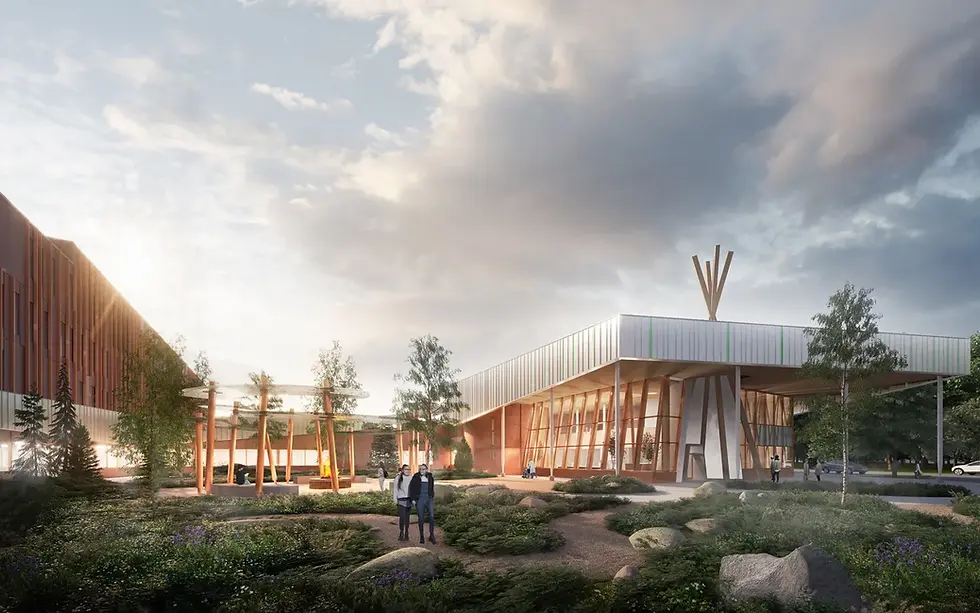
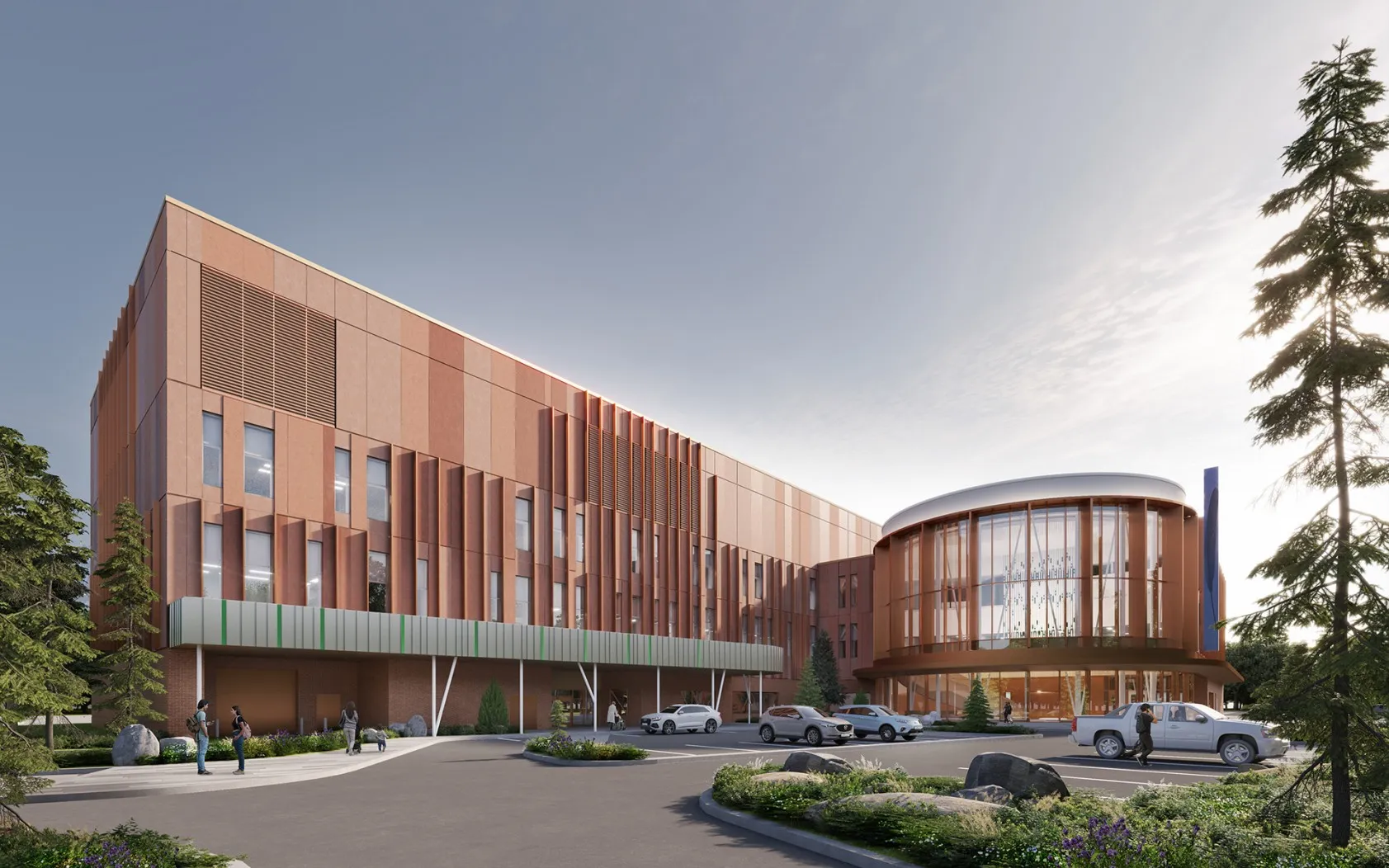
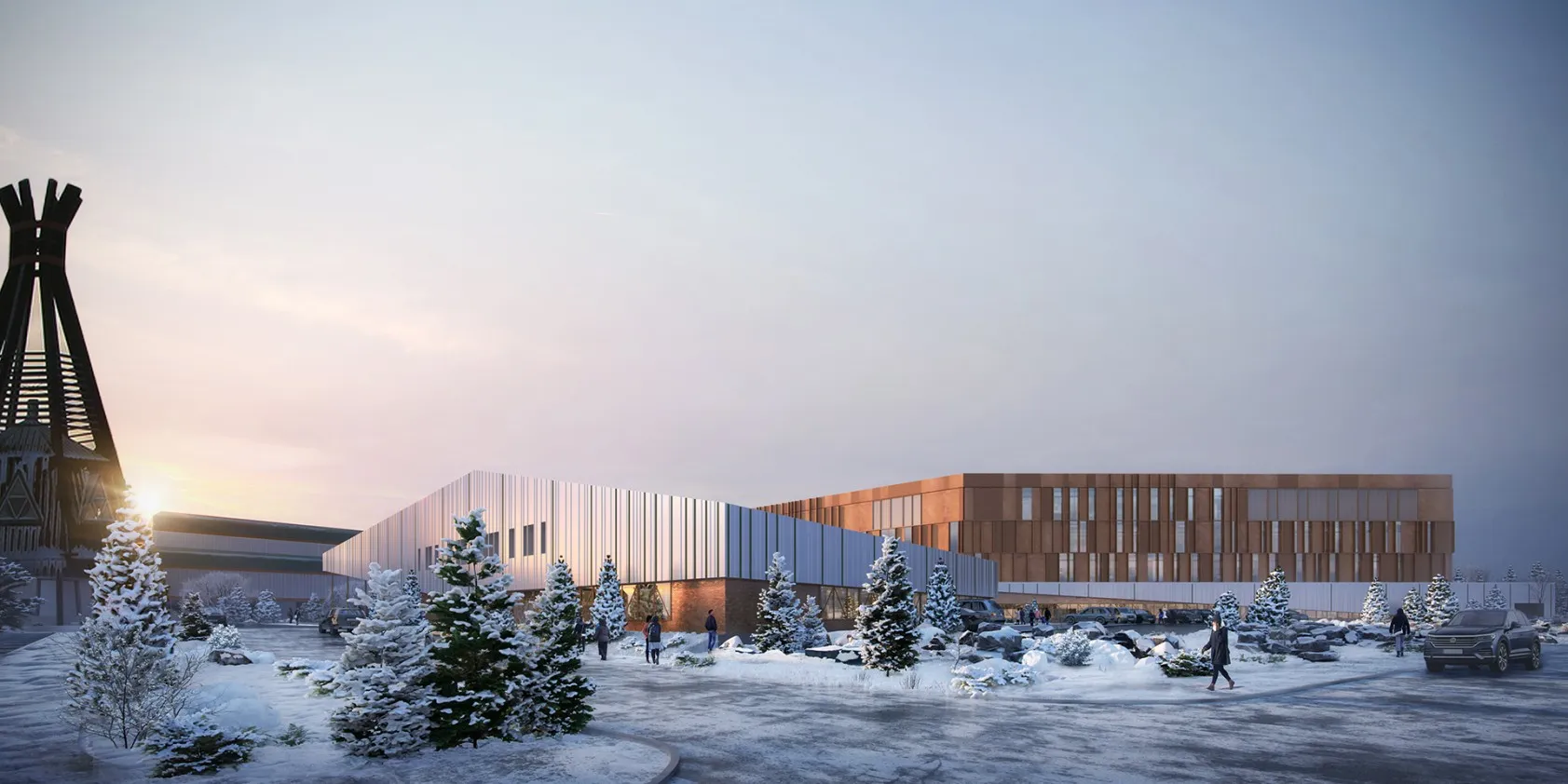
Drawing inspiration from significant indigenous symbols and the surrounding natural landscape, the building's rounded envelope acts as a landmark. The main hospital entrance features an expansive, multi-story mezzanine designed in the shape of a traditional drum, crowned by roofing materials reminiscent of a drumskin. At the opposite end, the community center's entrance mimics the distinctive form of a teepee, with a massive wooden structure rising skyward to create a sense of refuge under a forest-like canopy.
This inviting space evokes the rich textures of Nordic vegetation through its materiality and colouring. By deliberately blurring the threshold between the interior and exterior, the design achieves an impression of openness, grandeur, and respectful integration into the site.
"The construction of a new Regional Health Centre that will serve all of our people, not only the people of Chisasibi, is a major milestone in providing better access to services on the Territory. This new facility will enable us to provide many services currently not offered in Eeyou Istchee, and to enhance many others. All of these are crucial to the well-being of our people, to our commitment to bring Miyupimaatisiiun to the people of Eeyou Istchee." Chairperson Bella Moses PetawabanoCree Board of Health and Social Services of James Bay
Both a hospital and a community health center, the EIRHC is designed to ensure the Miyupimaatisiiun (health and well-being) of the population it serves. The 52-bed facility aims for LEED v4 certification and places the well-being of users, loved ones, caregivers, and staff at the center of its design.
To maximize efficiency and patient flow, the state-of-the-art complex is organized into three major sectors:
Hospital Care: Housing ambulatory activities, diagnostic and therapeutic services, hospitalization, and clinical and administrative support.
Prevention and Social Services: Home to the Chisasibi Community Miyupimaatisiiun Centre, providing front-line services, youth protection, and dental care.
Public and Common Spaces: Featuring the pharmacy, reception, a ceremonial room, catering services, and a cafeteria.
Funded by the Quebec Government, the project was announced by Danielle McCann, former Minister of Health and Social Services, alongside Sylvie D’Amours, Minister Responsible for Indigenous Affairs, and Denis Lamothe, MNA for Ungava. The CBHSSJB will own, manage, and operate the new center upon its completion.
Ultimately, the Eeyou Istchee Regional Health Centre will serve as a model for healthcare design, harmoniously combining state-of-the-art social and medical environments with the enduring culture and traditions of the Cree Nation.
Receive the latest updates on architecture, design, and sustainability, along with news of upcoming competitions, events, and exclusive stories, delivered directly to your inbox.
Great design bridges past and future,
creating spaces that evolve with us.
At Forma The Magazine, we believe architecture and design have the power to elevate lives, restore places, and inspire generations.
We invite you to join our community of thinkers, creators, and dreamers shaping the future of design.
Then there is Montréal—a city that, for twenty years, has chosen to "govern" itself. In June 2006, the Québec metropolis became the first city in North America and only the third in the world to join the UNESCO Creative Cities Network in the field of design. Two decades on, that designation has proven to be far more than a badge of honour. It has become the philosophical spine of an entire urban project.
Humans spent 99% of their evolutionary history adapting to the natural world. Today, we spend roughly 90% of our lives inside sealed, climate-controlled boxes. This massive shift has left us chronically stressed, fatigued, and disconnected.
Winner of the 2026 Award of Excellence in Architecture from the Quebec Association of Architects, the Aubé House is more than just a beautifully designed residence. It is a physical timeline—a space where a rich family history meets breathtaking modern design.
Just north of Toronto, perched on the edge of a wooded valley, sits Ravine House—a contemporary home that redefines what it means to live in harmony with nature. Rather than acting as a barrier against the outdoors or simply occupying a plot of land, this stunning residence acts as an immersive, beautiful mediator between comfortable domestic living and the natural landscape.
On May 29th, as the sun began to set over the historic brick facades of Old Town Toronto, the streets took on a new, electric energy. The King East Design District (KEDD) Neighbourhood Hop—the highly anticipated annual event presented by DesignTO in collaboration with the Old Town Toronto BIA—was officially underway. For a few magic hours, the neighbourhood morphed into a sprawling, interactive playground for creativity and innovation.
In the heart of Quebec’s rugged Laurentians region, a new kind of home has taken flight. Located in the quiet community of La Conception, The Albatross is not just a house; it is a masterclass in modern residential design. Image courtesy of: Stéphane Groleau Created by the teams at MU Architecture in close collaboration with architect Anik Patry, this extraordinary home was built around a beautiful, simple idea: to place a modern family at the very center of a spectacular nat
Great architecture does more than simply house people; it shapes how they learn, create, and connect with the world around them. Université du Québec à Montréal (UQAM) has long understood this, and the architectural community agrees. Recently, UQAM’s iconic pavillon de Design was awarded the Royal Architectural Institute of Canada’s (RAIC) Prix du XXe siècle, a prestigious honour that recognizes the most outstanding and enduring architectural achievements of the last century.
Medical laboratories are often defined entirely by their complex, technical needs, leaving little room for architectural beauty. However, the new Montérégie Central Laboratory in Quebec completely rewrites that rule. Designed by the architectural firms NFOE and Archi–, this cutting-edge facility proves that high-tech infrastructure can be surprisingly elegant.