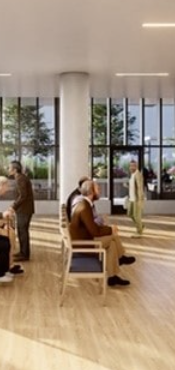
In the heart of downtown Toronto, a transformative infrastructure project is underway that promises to redefine how the city cares for its most vulnerable seniors. The Rekai Centre at Cherry Place is not just a new long-term care home; it is a direct response to the lessons learned from the COVID-19 pandemic.
Situated near the mouth of the Don River, adjacent to the vibrant Distillery District and Corktown neighbourhoods, this new 13-storey facility is being hailed as a "Campus of Care." While provincial standards for long-term care design have remained largely static since 2015, the team behind Cherry Place is pushing beyond the status quo to prioritize infection control, dignity, and community integration.
A Vision Born from Crisis
The design philosophy of the new Rekai Centre is rooted in the frontline experiences of the pandemic. Sue Graham-Nutter, CEO of the Rekai Centres, recalls brainstorming the facility's updates while navigating the crisis in real-time.
“I would go into the stairwell, in my full PPE, and I would text the designer with, ‘We need to think about this, we need to think about that,’ because I didn't want to forget the minor details,” Sue Graham-Nutter, CEO of the Rekai Centres,
Those details range from the strategic placement of garbage cans to high-level engineering solutions.
The redesigned facility will feature:
Infection Control Zones: Areas equipped with sealed doors to compartmentalize outbreaks.
Negative Pressure Rooms: Four specialized rooms designed to isolate infected residents, preventing virus spread.
In-Room Oxygen Supply: Selected rooms will have direct oxygen access, allowing residents to be treated on-site rather than requiring transfer to overcrowded hospitals.
Private Living: Every resident will have their own bedroom. While some bathrooms are shared, the design ensures that mobile residents are paired with those who require assistance, effectively creating a private bathroom experience for those who can use it independently.
Innovative Vertical Design
The Rekai Centre at Cherry Place faces a unique urban challenge: a long, narrow lot measuring approximately 24 meters by 100 meters (almost 79 feet by 328 feet), bounded by Cherry Street, Front Street, and Eastern Avenue. To accommodate 348 residents and necessary amenities, the design firm Montgomery Sisam Architects looked upward.
The 270,000-square-foot facility spans 12 floors of resident and amenity space (13 storeys total). Despite the density, the design prioritizes connection to the outside world. The building includes multiple terraces and roof gardens, offering green spaces, sandboxes, and sweeping views of the downtown core and Lake Ontario.
While the Rekai Centre is taking significant strides forward, experts argue that Ontario’s provincial standards are still lagging behind best practices.
According to a 2025 study by the National Institute on Aging (NIA), traditional long-term care homes saw over three times as many COVID-19 deaths and twice as many cases in 2020 compared to "small-scale" care homes. Dr. Samir Sinha, director of health policy research at the NIA, advocates for a model where households consist of just 10 to 12 people.
“If you think about palliative care hospices, if you think about group homes for younger people [...] we often don't have them living in large institutional settings [...]. So why is it that in North America we only do this with frail, older people?” Dr. Samir Sinha, director of health policy research at the NIA
Current Ontario standards allow for resident home areas of up to 32 people. While the province maintains these standards support the demands of a growing population, Dr. Sinha argues that smaller groupings are vital for survival and mental health.
The Rekai Centre is attempting to bridge this gap. Architect Dustin Hooper noted that some resident areas at Cherry Place are being built for smaller cohorts of 14 or 18 beds to create a more home-like atmosphere, surpassing the provincial requirement.
This building at Cherry Place is designed to be more than a residence; it is a holistic healthcare hub.
The facility will include:
A Dialysis Clinic: Providing critical treatment on-site.
A "Rainbow Wing": Dedicated to culturally sensitive and inclusive care for LGBTQ+ seniors.
Dementia Care: Designated floors specifically designed for residents living with cognitive decline.
Family Accommodations: Suites where families can stay while visiting loved ones.
Crucially, the centre will address the staffing crisis in healthcare through a partnership with Humber College. The building will house a 50-student co-op school program, providing an immersive education center for new Personal Support Workers (PSWs) and Registered Nurses.
The realization of this project was made possible through the Building Ontario Fund, which has entered into an agreement in principle to finance the project alongside a major Canadian bank.
Rekai Centre at Cherry Place is a prime example of how the Building Ontario Fund is driving development of vital infrastructure in Ontario by working hand-in-hand with institutional capital and great partners like The Rekai Centres [...]. The concept of Cherry Place has been in development for a long time, but progress was stalled due to a combination of factors, including financing challenges. With the Building Ontario Fund’s investment, the project is able to move from vision to reality. We are thrilled that this innovative facility can now come to life, providing much-needed beds and services within a high-needs community, and that our first project is such an impactful one.” Michael Fedchyshyn, CEO, Building Ontario Fund.
Peter Bethlenfalvy, Ontario's Minister of Finance, emphasized that this investment is key to developing a resilient long-term care system. With over 49,000 people on the waitlist for long-term care in Ontario as of early 2023, the 348 new beds are a critical addition to the province's goal of creating or renewing 58,000 beds by 2028.
With financing secured and designs finalized, the Rekai Centre at Cherry Place is moving toward construction. The facility is expected to welcome its first residents in June 2028, with the waitlist opening in January of that year.
As the concrete rises on Cherry Street, it represents hope—not just for the families who will rely on its care, but also for a healthcare system that is desperately in need of innovation.