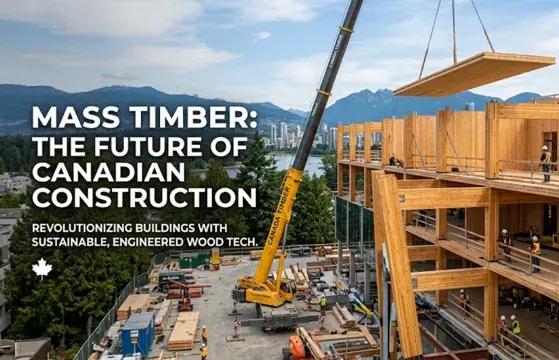
Across Canada, the housing crisis, climate change, and a shortage of construction workers are prompting people to look to the forests for answers. Engineered wood, once mostly used for eye-catching university buildings and demonstration projects, is now expected to play a much bigger role. It is on track to become a regular part of construction across the country.
This change shifts the focus. People no longer wonder whether cross-laminated timber can make attractive buildings—it has proven that many times over. Now, the real question is whether Canada can use its forests, factories, and design skills to create a system that builds homes faster, cuts carbon emissions, and keeps more manufacturing jobs in the country.
For a long time, mass timber in Canada was mainly used for special projects, such as striking university buildings or unique fire halls, proving that wood could stand up to steel and concrete. But this is no longer unusual. Today, over 750 mass timber projects have been built or begun across the country, covering almost three million square metres.
British Columbia remains the hub for mass timber construction, with over 550 finished or ongoing buildings, the most in North America. Quebec has built up strong manufacturing to meet its goals, while Ontario has quietly become the biggest source of demand, with more than 300 projects planned or underway. Hailey Quiquero from WoodWorks Ontario believes the province could eventually use mass timber in up to 10% of all new construction if the industry also develops the necessary community culture for tall-timber construction.
Annabelle Hamilton, Executive Director of WoodWorks BC, puts it this way: the industry, she says, "has largely proven that mass timber works." She believes the next step is not about proving the material anymore, but about making it common—something repeatable and accessible far beyond just a few showcase projects.
Ottawa is backing this goal with real funding. In June 2026, the federal government pledged nearly $130 million to 56 projects focused on growing mass timber manufacturing and its supply chain. These projects include a robotics-driven housing factory in the Greater Toronto Area that can produce about a thousand units a year, an AI-assisted glulam upgrade at a mill in St. Thomas, Ontario, and an experimental Winnipeg apartment building testing new stairwell designs for taller wood buildings. A large part of this funding also supports Indigenous-led forestry and manufacturing, such as a facility upgrade in Sand Point First Nation and a new mill in Wemotaci, Quebec.
Now that raw materials and funding are in place, the harder job is building the systems around them. This means updating codes, changing how projects are bought, and creating shared parts so architects, manufacturers, and builders can work together more easily. The focus is moving from single buildings to what the industry calls modern methods of construction. These methods use prefabricated parts, faster assembly, and digital modelling based on a set of repeatable components rather than a unique design for each project.
Carol Phillips from Moriyama Teshima Architects is a leading voice on what standardization should protect. For her, bringing manufacturers into a project early lets designers and suppliers work together on issues such as available wood species, panel sizes, and shipping plans. Standardization should set a minimum standard, not a limit, including decent room sizes, accessibility, and shared amenities in buildings across the country. In her view, regional character builds on top of that baseline, so climate, culture, and community can still influence how each project looks and feels.
This approach is already appearing in research designed for real-world use. A recent study by the architecture firm Perkins&Will proposes a prefabricated, modular mass-timber housing system built on a simple structural grid and a small set of repeatable parts. The aim is to speed up design, approvals, and assembly. The system can also adapt to different unit types, facades, and even fully flexible floor plans without changing its basic structure. This shows that prefabrication does not have to make every building look the same.
Even with all the focus on factories and repeatable systems, the material itself still invites a personal connection. At Toronto's Limberlost Place, a ten-storey mass timber classroom building for George Brown College, students often run their hands along the columns as they walk by. Architect Phil Silverstein has said the way visitors react to the building is unlike anything he has seen before. There is something about the exposed wood, with its knots and growth rings, that draws people in instead of keeping them away.
That same feeling brought Swiss master timber framer Sigi Liebmann to Golden, British Columbia, almost thirty years ago for what was meant to be a short consulting job. He ended up staying and started International Timberframes, a company known for dowel-laminated timber panels that use hardwood dowels instead of glue. This choice is both philosophical and technical. By avoiding adhesives, the panels remain fully recyclable, and the air inside the finished building stays free of off-gassing.
For Liebmann, sustainability is not just a marketing term but a daily practice. He keeps Highland cattle and bees on a farm outside town, heats his manufacturing facility with a furnace powered by his own wood scraps, and uses spent brewery grain as fertilizer for his livestock. "Sustainability is not just a word—it's actually a lifestyle," he says. That same closed-loop approach is part of every panel his company now ships across North America.
Fire performance remains the most common question about mass timber, and now insurers, not just building inspectors, are asking it. Large timber pieces char on the outside when exposed to heat, creating a protective layer that helps the structure stay strong. Still, this science does not calm every insurer’s concerns. Charbel Bou Farah of Zurich Resilience Solutions Canada says it comes down to timing: insurers care less about a building’s structural performance and more about whether project teams manage moisture and logistics early in the process. The domestic and export mass timber market is projected to reach roughly $1.2 billion by 2030, assuming manufacturing capacity and supply chains keep pace with demand. Europe and Asia are pouring investment into the same technology, which means Canada's head start—built on genuine forestry advantages few countries can match—is not something the country can afford to take for granted.
The true sign of success will not be another eye-catching tower. It will be when everyday apartment buildings, schools, and fire halls are built with wood as a normal practice, not just as a test. As a recent industry strategy report says, mass timber ‘becomes useful when it is scaled as manufacturing,’ and by that measure, Canada’s forests are just getting started.