For decades, the Metropolitan Expressway (Autoroute 40) has been the backbone of Montreal’s transit, but it has also been a scar running across the island. Built in the mid-20th century, this elevated concrete ribbon divides neighbourhoods, creates noise and pollution, and occupies valuable urban space.
As the government prepares for a major rehabilitation to extend the highway's life by another 25 years, a critical question arises: Should we simply rebuild the past, or reimagine the future?
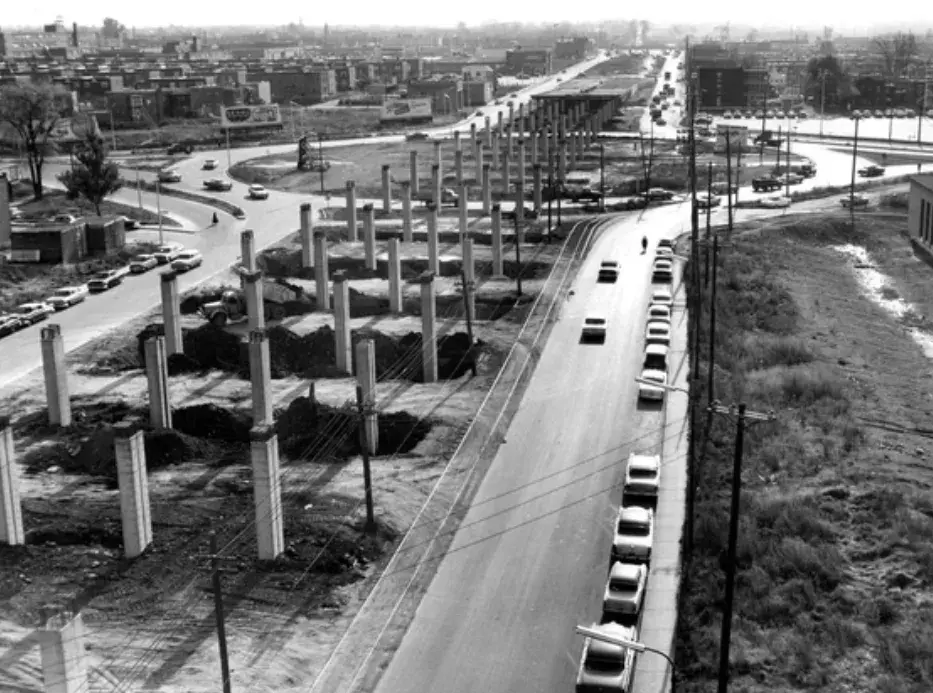
To understand the future, we must look at the past. When the Metropolitan was announced in 1960 as part of the Trans-Canada Highway system, it was hailed as a triumph of modernization. It was designed to speed up travel from Ste-Anne-de-Bellevue to the Bout de l’Île Bridge.
However, the reality of 1960s planning has clashed with 21st-century needs. Today, the stretch between the Côte‐de‐Liesse and Laurentian interchanges carries the load of two separate freeways (the A-15 and A-40). Sophisticated traffic modelling reveals that the highway is chronically oversaturated. Because of complex weaving patterns and bottlenecks outside the corridor, simply adding more lanes won't fix the congestion. We need a solution that addresses fluidity, not just capacity.
The architectural firm Lemay has proposed a bold alternative to simple renovation. Instead of leaving the highway as an open wound in the city, they propose covering the elevated lanes with a massive structural deck.
This "linear park" concept would transform the expressway into a catalyst for positive change:
Housing & Development: The deck could support new rental units and social housing, directly addressing Montreal’s housing crisis.
Green Space: A park stretching several kilometres would filter air pollution, reduce the urban heat island effect, and reconnect neighbourhoods that have been cut off from one another for 60 years.
Sustainable Transit: The design prioritizes efficient public transit, reducing car dependence.
This isn't science fiction. Cities like Washington D.C. (Capitol Crossing), Stockholm (Slussen), and Paris (Rive Gauche) have already successfully turned air rights above highways into thriving urban districts.
While the "deck" proposal represents a long-term vision, there are immediate opportunities to improve the fabric of the city beneath the highway.
Municipal leaders and community groups, including Projet Montréal, are advocating for a "humanization" of the space under the Metropolitan. Rather than a dark, concrete wasteland, the areas surrounding key intersections—such as the Crémazie metro, Collège André-Grasset, and the Saint-Michel school corridor—could be transformed.
By installing better lighting, skateparks, sports fields, and safe pedestrian crossings, we can turn the "under-gardens" of the highway into active community hubs. This ensures that while we wait for a total transformation, residents don't have to live in the shadow of neglected infrastructure.
The Metropolitan Expressway sits on immense acreage in a densely built area. Rebuilding it "as is" would be a missed opportunity of historic proportions.
Whether through Lemay’s ambitious deck covering or an aggressive revitalization of the ground-level space, we must demand more than just concrete repairs. We have the chance to turn a source of division into a model of climate resilience, affordable housing, and urban beauty.
As we approach the reconstruction dates, let’s mobilize national expertise and community voices. Let’s not just patch the road; let’s heal the city.